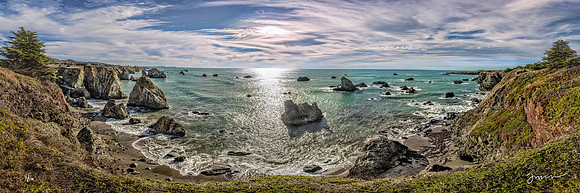
God's Jacks
Location: Gleason Cove Beach and Duncan’s Cove Headlands, Sonoma County, CA
Created 11/25/17 04:44:17 pm
Camera: Canon EOS 5D Mark III
Lens: EF16-35mm f/4L IS USM
Aperture: f/10 ; 1/250 sec; ISO 1000; HDR pano; 36 shots (12x3); stitched in Photoshop
Just ½ mile north of Wright’s Beach, Duncan’s Cove is located about half-way between Bodega Bay and Jenner along the Sonoma County coastline.
This stretch of headlands is a sight to behold. On sunny, mild days like in this photo, the colors of the water and surrounding point are strikingly brilliant and the view up and down the coast is breathtaking. On a windy or stormy day you will sprayed by crashing waves. Even in the fog this place is magical.
A headland is a coastal land-form that is quite high, and has a sheer drop that extends out into the sea or ocean. Parts of the headland that jut out into the water slowly get eroded over time by the mechanical energy of winds and waves. Essentially, the softer and weaker part of the rocks gets eroded and break away, leaving behind the harder and stronger rock. The rocks jutting out of the ocean are called “stacks”. A stack or sea stack is a geological landform consisting of a steep and often vertical column of rock in the sea near a coast, formed by wave erosion. ... The force of the water weakens cracks in the headland, causing them to later collapse, forming free-standing stacks and even a small island.
This random array of sea stacks reminded me of the children’s game of Jacks. Jacks, also called jackstones, fivestones, or dibs, is a game of great antiquity and worldwide distribution, played with stones, bones of animals, seeds, cloth-filled bags, or metal or plastic, with or without a ball. The name derives from “chackstones”—“stones to be tossed”. The Such objects have been found in prehistoric caves in Kiev, Ukraine, and pictures of the game are depicted on jars from ancient Greece.
It is interesting to note that, the destructive powers that create a sea stack are also the ones that eventually destroy it. The waves and winds continue to erode the remaining hard rock that comprises the structure of the sea stack. It is a process that may take thousands of years. But eventually, long after many generations have come and gone the outcome is that the structure becomes too weak, and the sea stack collapses under its own weight.
If you look closely, on the right side of this photograph, just near the large cypress tree on the right, you can see a woman sitting on the cliffs edge in the photo, it appears to me she is the center of the scene, and the world unfolds before her.
A small reminder of how large our world is to us, and comparatively, how small we are in this universe so vast and mysterious.