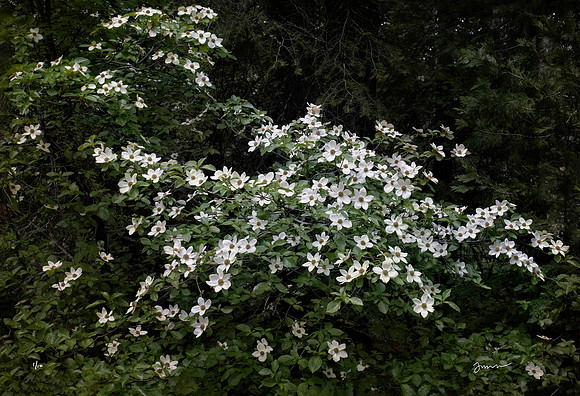
Dogwoods at French Meadows Lake, CA
The rare treasure of finding an area of dogwood trees blooming are instantly and passionately delightful, usually 10 - 30 feet tall, they often instill a feeling of awe and peacefulness better than any flowering tree I have seen.
The flowers, or at least what appear to be the flowers, are large, typically 3 or 4 inches across. They are not in fact single flowers, though, but heads of tiny flowers surrounded by white petal-like bracts. They bloom in bunches, making a flowering dogwood tree an stunning sight.
A true California native beauty is the Pacific, or Mountain Dogwood (Cornus nuttallii). Cornus is the Latin word for horn, referring to the hardness of the wood. Nuttallii is homage to English botanist Thomas Nuttall (1786 - 1859). The dogwood display begins in the spring with exotic looking blooms, continues into late summer, with the development of startling cluster-fruits, then ends in autumn with a finale of branches filled with crimson leaves. Some of the best ecosystems to experience dogwoods are here in Tuolumne County along streams and ditch trails, as well as on the shadier sides of the mountains below 5000 ft.
Dogwoods are endemic to the western slopes of the Sierra Nevada and Cascade mountains from British Columbia to Southern California. They can also be found in coastal areas along the Pacific. They thrive in small niches of the Sierra Nevada, as they prefer hot summers and cold winters, and grow well with moderate amounts of rainfall and snowmelt. They need partial shade because their thin bark must be protected from the sun. Dogwoods are often seen growing under the canopy of larger trees in our mixed coniferous forests, or surrounded by an understory of native shrubs. A unique characteristic is that dogwoods can photosynthesize maximally in 1/3 of a portion of full sunlight; thus, shady forests do not hinder their ability to make food.
The eye-catching flowers begin to bloom sometime between April and June depending on elevation and conditions; sometimes there can be an additional flowering in the fall. The white showy petal-like structures are actually modified leaves called bracts. There are 4-8 bracts per bloom; each are 2-3″. The bracts surround a greenish-white center that contains 30-40 small true flowers. These florets eventually develop into a type of fruit called a drupe by late summer. Each drupe is bright red to reddish-orange in color, about ½” in length and contains a cluster of 50-100 seeds. Emulating from such a delicate stature, this shrub offers some of the rarest sense of tranquility we find in our forests.