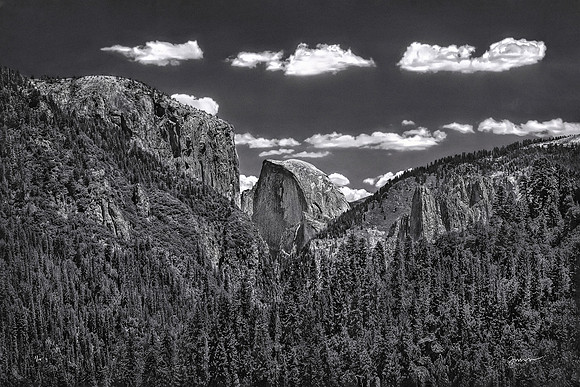
Three clouds and Half a Dome
The local Ahwahneechee Native Americans named Half Dome 'Tis-se’-yak,' which means "Face of Young Woman Stained with Tears" due to the colonies of brown-black lichens that form dark vertical drip-like stripes. Half Dome, rising 4,737 ft above the valley floor, is one of Yosemite's most iconic landmarks. As late as the 1870s, Josiah Whitney of the California Geological Survey described it as "perfectly inaccessible." George G. Anderson did accomplish a Summit climb in October 1875, nonetheless not via the Northwest Face. The first attempt to climb the infamous Northwest Face was made in 1954 by Dick Long, Jim Wilson and George Mandatory. Unfortunately, they only managed to climb 175 feet before retreating. In 1955, Jerry Gallwas, Don Wilson, Royal Robins, and Warren Harding made a serious attempt to find a passage. However, after climbing a mere 500 feet over five days, they, too, retreated.
Gallwas and Robbins, armed with new chrome-molybdenum pitons made by Gallwas, recruited Mike Sherrick and set off on June 24, 1957, determined this time to finish the route. Their five-day epic summit was the first Grade VI climb in the United States. In 2008, at age 22, Alex Honnold achieved the first solo ‘free-climb’ of the Northwest face. Four years later, after repeating the solo a number of times, he did it in a mere one hour and twenty-two minutes. In 2017, he also climbed El Capitan without using ropes or other safety gear in 3 hours and 56 minutes, completing what may be the greatest feat of pure rock climbing in the history of the sport.
Today, thousands of hikers reach the top each year by following a backdoor 8.5-mile trail from the valley floor, including hundreds of feet of granite stairs, and the final pitch up the East Face with the aid of a pair of post-mounted steel cables, which are installed annually. This cable pathway is set initially close to the 1919 Anderson route. The sheer expanse of solid granite and the vast sea of trees have a spiritual, soothing effect on me. It's fascinating how the same scenery can appear so different from various viewpoints. When nestled among the forest, Half Dome seems like a round dome that has lost its northwest half. However, this is just an illusion. From Washburn Point, it appears as a thin ridge of rock, an arête, with its southeast side almost as steep as its northwest side, except for the very top. It's amazing how our one-time perception of things can be significantly influenced by perspective.