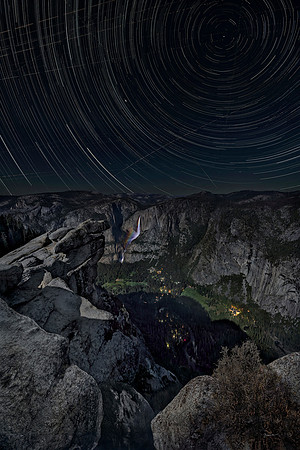
Glacier Point Full Moon with Yosemite Falls Moonbow 40" x 60"
This night-time image of Yosemite Falls’ moon-bow, during a full moon, was captured on May 21st at 11:59 pm. Created by the rays of the moon instead of the sun, a moon-bow occurs when light refracts in water droplets rising from the thunderous mist at the waterfall's base. John Muir compared the moon-bow to a religious experience, describing it as a "grand arc of color, glowing in mild, shapely beauty." While the phenomenon is thrilling to behold, it also proves elusive. Moon-bows actually appear different when viewed with the naked eye. Those with excellent night vision can sometimes make out a faint spectrum of color, while most see only a luminescent arc of whiteness spanning the mist. Long-exposure photography is the only fool-proof way to capture this ephemeral subject. The conditions and geometry must be perfect to capture a moon-bow, and are present merely minutes per year. Factoring in all the variables, such as the road to Glacier Point must be open, a less than colossal snowpack, clear skies, enough mist, a dark night, and the bright, unobstructed moonlight are all non-negotiables.
This year’s abnormally high snowmelt, during the peak mid-May runoff, show Yosemite Falls in all its glory. The Upper Falls' sheer size, at a 1,430-foot drop, coupled with the Middle and Lower Falls, which add another 995 feet, makes it a fantastic 2,425-foot fall, the tallest drop in North America.
Only in April, May, and June can one briefly glimpse the moon-bow. Here, from the top of Glacier Point, located on the south wall of Yosemite Valley, you are at an elevation of 7,214 feet; sitting 3,200 feet above the Ahwahnee Hotel (on the Valley Floor), seen lit up in the lower right corner of the photograph.
The native Ahwahneechee people called the waterfall "Cholock" ("the fall") and believed that the plunge pool at its base was inhabited by the spirits of several witches, called ‘the Poloti.’ An Ahwaneechee folktale describes a woman going to fetch a pail of water from the pool, and drawing it out full of snakes. Later that night, after the woman had trespassed into their territory, the spirits caused the woman's house to be sucked into the pool by a powerful wind, taking the woman and her newborn baby with it. Apologies for another buzz-kill.
The sky's Star Trails relate to the Earth's rotation, spinning on its axis almost perfectly aligned with the North Star. Thus, Polaris remains a dot in this time-lapse. The Earth revolves around the Sun at a rate of about 67,000 miles per hour, or 18.5 miles a second. At the same time, Earth rotates around its axis at about 1,000 miles per hour. Since the Earth rotates at a near-constant speed—that is, it doesn't speed up or slow down in any way noticeable to us—we simply spin with it and don't feel a thing. The atmosphere moves with the Earth at the same speed, and also rotates with the Earth. So, the relative motion between Earth and air is almost zero. The blinking colored light trails are passing planes; and the brighter short bursts of light trails are captures of at least 6 meteors.
As a constant reminder of how vast our universe is, consider that the light from some stars took millions of years to reach our mortal eyes, at the speed of light, 186,000 miles per second. Conversely, it takes light merely 320 years for Polaris' light to reach Earth.
This exposition is created from a succession of 979 shots, taken at a shutter speed of 6 seconds each, over a period of about 3 hours. Later, the shots were stacked together in Photoshop, culminating in a single breathtaking otherworldly image.