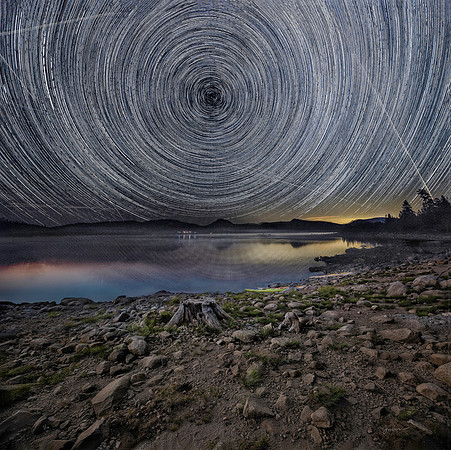
Loon Lake Spin
It was a cold night, on the peak of the Perseid Meteor shower. Comet Swift-Tuttle is the source of the Perseid Showers, whose debris creates the prolific show each year in mid-August. The comet is the largest object known to make repeated passes near Earth. Its nucleus is about 16 miles across, roughly equal to the object that wiped out the dinosaurs. During our annual three-day kayak camp-out, on the night of a new moon, I set up my tripod to capture the extraordinary night sky that our mortal eye does not see. This image was accomplished in two hours by consecutively stacking a succession of 203 shots at 25 seconds each, which were then composed later in Photoshop. I started about an hour and a half after sunset. On this moonless night, you see the lingering glow of the ambient sunset revealed on the lake reflection on the left. The light glowing on the right is the eastern horizon’s light pollution from Tahoma, Tahoe City, and Truckee. The small bright pinpoints of light on the center shoreline along the far side of the lake, are campfires from campsites and tents. Night photography has long been a favorite. I love the fascinating colors, textures, and shapes revealed under limited lighting conditions. Star trails (and the Milky Way) are some of the most gorgeous subjects. It's almost unfathomable that the starlight we see travels millions of years to reach us, adding an abstract and surreal feel to the landscape. The Earth rotates around the north and south poles; so all these star trails are centered and are rotating around one point. This center point in the photo is the North Star, ‘Polaris.’ By the way, we saw about 10 sizzling meteors in the five hours that night, although not exactly the 60-70 per hour forecast; what a night to remember.